
'Can you believe there are over 26,500 deaths linked to heatwave-driven ozone in 2024?'

Health experts warn that rising temperatures could create a growing burden of silent and cumulative health stress across the population.

Schools in Delhi are taking precautionary measures to protect students from the ongoing heatwave, including suspending outdoor activities, shifting assemblies indoors, and considering early closure for junior classes.

Several parts of India are experiencing a severe heatwave, with temperatures soaring past 44 degrees Celsius. States are issuing alerts and taking measures to protect people and animals from the extreme conditions.
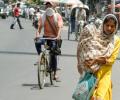
North India is experiencing an intense heatwave, with temperatures soaring to 48 degrees Celsius in some areas. Several states have issued warnings and advisories as the heatwave is expected to continue.

India's peak power demand reached an all-time high of 257.37 GW on Monday, driven by increased use of cooling appliances during an intense heatwave, according to power ministry data. The Indian Meteorological Department has forecast continued heatwave conditions in northwest and central India.

Large parts of India are experiencing a severe heatwave, with temperatures soaring to dangerous levels. Authorities have issued alerts and health advisories as the heatwave intensifies across multiple states.

Delhi Chief Minister Rekha Gupta has instructed officials to ensure the transparent and timely implementation of welfare schemes announced in the budget. She also appealed to the public to take precautions during the ongoing heatwave.

Many places across northern states including Delhi recorded above-normal temperatures crossing 40 degrees Celsius, while the India Meteorological Department warned of heatwave conditions in parts of Uttar Pradesh in the coming days. Jammu and Kashmir saw a dip in temperatures with fresh snowfall in the higher reaches and rainfall in the plains.

Veterinarians and animal rescuers in Delhi report a surge in cases of heat-related illnesses among birds and stray animals as the city grapples with a severe heatwave. Dehydration, heatstroke, and gastrointestinal infections are rampant, prompting calls for residents to provide water and shade for animals.

Delhi Chief Minister Rekha Gupta has directed officials to ensure the transparent and timely implementation of welfare schemes announced in the budget, warning of potential fund reductions for departments failing to utilise allocated budgets effectively.

The maximum temperature at the Safdarjung Observatory, Delhi's base station, is likely to rise to 45 degrees Celsius.

Northern states in India are experiencing severe heatwave conditions, with temperatures reaching up to 46.6 degrees Celsius. The heatwave has impacted daily life, leading to a decline in tourism and increased power demand. Authorities have issued advisories and implemented measures to mitigate the effects of the extreme heat.

'People told me to go back to school and leave climate issues to adults. But if adults had done their job, I wouldn't be here protesting.' At just 14, climate activist Licypriya Kangujam says children are paying the price for a crisis they did not create, while governments continue to make promises without delivering meaningful change.

India's retail inflation, measured by the Consumer Price Index (CPI), increased to 3.48 per cent in April, up from 3.40 per cent in March, primarily due to a surge in prices of gold and silver jewellery, as well as certain kitchen staples like tomatoes and cauliflower.

'During the hot season (April to June), above-normal minimum temperatures are likely over most parts of the country, except in some regions of Maharashtra and Telangana, where minimum temperatures are expected to be normal to below normal,' IMD said.
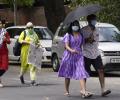
The India meteorological department said heatwave conditions will persist for at least two more days.
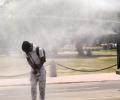
Delhi is experiencing its first heatwave of the season, with temperatures reaching 40.2 degrees Celsius. Doctors have warned that exposure to extreme heat can lead to a range of health issues, from mild rashes and muscle cramps to serious conditions like heat exhaustion and heatstroke. They advise staying hydrated, avoiding outdoor activities during peak hours, and wearing light, breathable clothes. Vulnerable groups like children, the elderly, and those with pre-existing conditions are at greater risk.
India is expected to experience hotter-than-usual temperatures from April to June, with more heatwave days in central and eastern India and the northwestern plains, the IMD said. Most parts of the country will see higher-than-normal maximum temperatures, except for some areas in western and eastern India where the temperatures are expected to be normal. Minimum temperatures will also be above normal in most regions. The IMD has warned that landslides could occur in parts of Kerala and Karnataka in the Western Ghats and that northeastern states might face flooding in April.
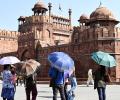
In Rajasthan, Pilani recorded 44.9 degrees Celsius, Phalodi and Churu touched 43.8 degrees Celsius and 43.5 degrees Celsius respectively, while Bikaner and Jaipur registered 43.4 degrees Celsius and 43 degrees Celsius.

Heatwave conditions are expected over northwest India during the next five days, with Punjab, Haryana, Rajasthan and Delhi predicted to bear the maximum impact, the India Meteorological Department (IMD) said on Thursday.

The India meteorological department predicted mainly clear skies with heatwave conditions in many parts of Delhi and severe heat wave conditions in other areas.
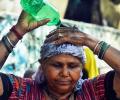
With the summer approaching sooner than scheduled, Maharashtra, Telangana, Odisha, and West Bengal have already started experiencing heat waves with temperatures soaring above 40°C.

Temperatures remained above 45 degrees Celsius in large parts of Rajasthan, Haryana, Delhi, Chandigarh and Uttar Pradesh, affecting daily life as many chose to remain indoors in the afternoon.

After a long and harsh spell of heatwave, Delhi witnessed a pleasant morning on Thursday, with the weather department saying parts of the national capital received light rains.
Temperatures are likely to remain in a similar range until Thursday, with a gradual fall expected from June 13.

As Singapore, New York and Melbourne have shown, cities can mitigate the impact of heatwaves if they have the will to create green infrastructure, explain Amit Kapoor & Bibek Debroy.

Heatwave may abate over most parts of North India in next two days; temperatures likely to drop by 2-3C.

Delhi sweltered under intense heat as the Safdarjung observatory, considered the official marker of the national capital, noted a high of 43.8 degrees Celsius, four notches above the normal average.

Srinagar recorded the maximum temperature of 35.6 degrees Celsius on Wednesday, the highest temperature in the month of July in 25 years since 1999 when the mercury had settled at 37 degrees Celsius, the officials said.

Temperatures in 17 locations breached 45 degrees Celsius on Monday, with the punishing heat affecting health and livelihoods.

To ensure immediate cooling of the body, the hospital has set up a first-of-its-kind heatstroke unit.

Among the fatalities recorded on Friday, the maximum 17 were from Uttar Pradesh, 14 from Bihar, five from Odisha and four from Jharkhand, where officials said more than 1,300 people are hospitalised with heatstroke conditions.

The India Meteorological Department has issued an 'orange' alert.

The unrelenting heatwave sweeping large parts of the country has claimed at least 110 lives and left over 40,000 people grappling with suspected heatstroke between March 1 and June 18 this year, health ministry sources said on Thursday.

The threshold for a heat wave is met when the maximum temperature of a weather station reaches at least 40 degrees Celsius in the plains, 37 degrees in coastal areas, and 30 degrees in hilly regions, and the departure from normal is at least 4.5 notches.

The India meteorological department has issued a yellow alert, warning of a fresh heatwave spell in Delhi which may see temperatures soaring to 44 degrees Celsius by Wednesday.
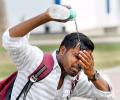
Heatwaves claimed more than 17,000 lives in 50 years in India, according to a paper authored by M Rajeevan, former secretary of Ministry of Earth Sciences, along with scientists Kamaljit Ray, S S Ray, R K Giri and A P Dimri.

The mercury at the Safdarjung Observatory is expected to breach the 43-degree mark on Thursday and touch 44 degrees Celsius by Friday, according to the India meteorological department.

The heat wave is likely to impact parts of Jammu and Kashmir, Himachal Pradesh, Uttarakhand, Punjab, Haryana, Delhi, Rajasthan, Madhya Pradesh, Jharkhand, Odisha and Gangetic West Bengal, the Met office said.
